28.9.10

new blog

follow my new blog, news, updates, pictures, music uploads, videos and waffle atyscolan.tumblr

21.6.08

Morriston Fiddle Maker

from the bbc
http://news.bbc.co.uk/1/hi/wales/south_west/7452522.stm


Concert celebrates violin maker


Lewis Roberts's violins are worth over £1,000 each on the open market
The work of a man regarded by some as Wales's greatest violin maker is to be celebrated at a concert at the chapel where he was buried in 1917.
Lewis Roberts of Morriston near Swansea made 87 instruments during his career and six will be played by a variety of musicians at Capel Seion Newydd.
Roberts, who was born in 1868 and made his first violin while in his teens, influenced several contemporaries.
The concert on 21 June is free to the public.
It has been organised by local antiques expert John Carpenter who has also researched the violin maker's life story.
"He was without any doubt the best [violin maker] Wales has ever produced," he said.
"Lewis Roberts was a violin maker who is described as a 'dreamer of dreams', which I have used as the title to my book.
"He worked in the tin industry, was a bachelor as far as we know and died at a young age pneumonia.
"He had have a brother - Willie Roberts - who was very well known locally as a violin player."
Mr Carpenter said he Roberts' mother had tried to discourage her son from violin making but he fashioned his first secretly in the back garden of their house in Morriston partly with a penknife.
He said what marked them out was the "neatness of his work".
Mr Carpenter's interest in Roberts was sparked around 20 years ago when he first acquired one of his violins.
"I have been an antique dealer most of my life and have played the violin since I was five years old.
"I have since bought another three - all of which will be played on the night along with another two."
The concert starts at Capel Seion Newydd at 1900BSTon Saturday 21 June.

9.1.08

preseli


Dv dy uarch du dy capan.
du dy pen du dy hunan
i adu ae ti ysgolan.

Mi iscolan yscolheic
ysgawin y puill iscodic.
guae ny baut a gaut guledic.

O losci ecluis. a llat buch iscol.
a llyfyr rod y voti.
vy penhid. ys trum kynhi.

Creaudir y creadurev. perthidev muyhaw.
kyrraw de imi vy gev.
ath vradas te am twyllas ynnev.

Blyutin llaun im rydoded.
ym. bangor ar paul cored.
Edrich de poen imy gan mor pryued.

Bei ys cuypun ar vn. mor amluc guint.
y vlaen bric guit fallum.
ar a vvneuthum e bith nys gunaun.


mountain gavotte
as plain as wind before the branch
words clothe articulate nature

here, life is movement
but slow

preseli trees are traces of time
tracks from a seeds urge
their shape the path of their history

bent by a crow's beak the scholars'
black flute twists the branch
persuaded by light, directed by wind

brilliant, unsymbolic lines
the mark of the action
taut against the reflected ocean sky

beverley evans reading the text here

23.12.07

branwen bendigeidfran gwales. yscolan & adar rhiannon. manawyddan lludd belinos lugobelinos a'r fisher king

branes yw'r hen air am heidio'r brain. nid o'r castell ond o'r fan hyn welodd bendigeidvran vab llyr llonge yn dod o werddon


mulfranwen yw'r enw am y deryn yma sy'n lluaws ar ynys gwales yn sir benfro


a branwen oedd whâr bendigeidfran a fuws ar ynys gwales, ne o leia'i ben hyfryd am 80 mlyned.


nes i heilyn vab gwyn agored y drws mynna manawyddan na ddylid ei agored. dyma lun david jones 'manawyddan's glass door'


cyn hyn yr oeddent yn ôl yn harlech am gyfnod lle ganws adar rhiannon iddynt


drudwns oedd adar rhiannon. wedyn aethpwyd â pen bendigeidfran fan hyn i wynebu tua ffrainc. ma bran yn gysylltiedig a'r fisher king, bron fyd achos y lôs gas e yn ei garffed


ma'r cigfrain yno o hyd.


fe gladdws lludd fan hyn, yn ludgate. lludd oedd yn fab i beli mawr ac yn gysylltiedig mynte rhai a lugh lamhada (a thrw hwnnw i lleu llaw gyffes) a lugobelinos, ac yn frawd i bran


a beli mawr fan hyn yn billingsgate. beli mawr oedd priod dôn, mam y mor, ac yr oedd e'i hun yn gysylltiedig a belenos - duw yr haul - apollo dim llai. belinos oedd tad bran


ceir yr hanes ar lein yn sysneg fan hyn . meddwl mâs yn uchel otw i, na gyd

's da'r tiwn a ganlyn ddim byd i wneud a'r uchod onibai am yr ail elfen. ty mawr yn nhgyffunie llandyfri yw glanbran. pam enwyd y nant cyferbyn yn bran, cwestiwn arall yw hwnnw


X: 1
T:glanbran
M:2/4
L:1/8
Q:250
K:G
G/A/|B2 Bd|G>A| BG|c2 B2|AA/B/ cA|
B>A Bd|G>A BG|Ad FA|G3:||
G|F>A G>B|Ac BA|G>B A>c|Bd BG|
B>A Bd|G>A BG|Ad FA|G3:||

dyma'r ty


ma bran i fran yn rhwle

14.12.07

welsh ballads. lord bateman, sweet william, siwsan lygatddu & the bishop of bangor


congratulation to the university of wales and particularly the welsh schools at university colleges bangor and cardiff for a new resource on line called cronfa baledi. it is a very usable site detailing authors, printers, sellers, catalogue numbers and tune lists of welsh language popular eighteenth century ballads, plus their first and last lines... and there's the rub


it is a pity that a quick comparison wih oxford's bodleian library collection of ballads exposes one final hurdle not crossed in terms of use to the general οἱ πολλοί on the university of wales site. 'what no pictures? said alice'. the bodleian not only gives us detailed photographs of these beautiful (and fragile - so nobody's fingering them) broadside ballads and a separate index for the woodcuts; but the site also has some midi files of the tune used. bingo.


it is of couse possible to retreive the catalogue number and see the mss for yourself at either bangor or cardiff but this is 21st century e-wales and for the artist who just wants to nick the words and tunes its a bit of a pity really. more hurdles to online viewing may be encountered here. another example of possibe frustration is to be seen below. in amongst a seemingly interminable ocean of religious balladry lies, temptingly, the ballad lord bateman. this is a screenshot of all we get


and on further perusal


nothing really to prepare us for the momentous discovery of this ballad, published in welsh speaking salop about a century before dickens and thackeray popularised the story of sofia and the owner of half of northumberland. here's one of the george cruikshank illustrations to dickens' words. the whole lot can be got here at the project gutenburg website


as it happens i copied the whole lot out by hand from the ms in bangor about a year ago. here's a free gift of it


C E R D D
o
hanes mab i wr BONHEDDIG
o
LANCASHIRE
AETH I DRAFEILIO

CYMERWYD hwn i garchar, o achos ei grefydd, yngwlad y Twrcs, a merch y brenin a’i ffan∫iodd ef, gan ddwyn yr agoriade, a’i ollwng ef yn rhydd gan wneuthur ammod a’u gilydd o doent i dro∫odd i Loegr ym hen y ∫aith mlynedd, gan bwyntio prïodas y cyfam∫er, ond y mab a brïododd un arall; ac ar y diwrnod y neithior daeth merch y brenin at ei haddewid, a bu ∫yndod mawr ar y mab, fe wrthododd ei wraig brïodol, ac a brïododd ferch brenin y Twrc.

gan EDWARD PUGH AP FYLLIN, Fardd
CROESOSWALLT
Argraphwyd gan J. SALTER
M, DCC, XCI,
Y MESUR A ELWIR
"NEW PRINCESS ROYAL"

I.
Gwyr a gwragedd dowch ynghyd,
hyna jeüenga’ brafia o bryd:
Clywch hanes mab bonheddig llon,
Aeth i deithio o’r wlad hon,
Ffordd i wledydd oedd digred
Gadawai ei wlad, i fynd ar led.
II.
I wlad y ffez Morocco’r aeth,
Bu arno yno gyflwr caeth;
Wrth rodio’r wlad nid rhad na rhwydd,
Cymerai’r Twrciaid e’n eu ∫wydd,
Rhodda∫ant ef mewn carchar cry’
Mynegaf ichwi fel y bu:
III.
Wylo’r dagre i lawr yn llyn
Yn y carchar ∫omgar ∫yn,
Dymunai dod’n ei wlad yn ol
Lle bod ymhlith rhai mor ddirol,

Lawr
Lawr i’r ∫eler ddu cadd fynd
Lle nid oedd posib gweled ffrind.
IV.
Y mab bonddigedd llariedd llon,
Hwn oedd heb gudd yn brudd i fron,
Mab oedd heb braw’ yn lan o bryd,
Carcharwr oedd ef yno o hyd,
O’r carcharorion daeth refiw
Fo oedd hawddgara’ lana’ ei liw
V.
Fe aeth un yno’n llon i’r llu
Sef merch y brenin atto fu,
Can wel’d mor lân o bryd a gwedd
Ffan∫iodd hon y mab mewn hedd,
Yn ei chalon yn ddi gudd
Ag ei∫iau cael y mab yn rhydd.
VI.
Yn y dyngiwn yn gla’ roddd dan glo,
Y ferch ofynnau iddo fo
Oedd ganddo fodd i’w brynnu’n rhydd.
A’r dagre’n rhedeg lawr ei grudd.
Dywedai ynte wrth y fun
Fod ganddo stât’n ei wlad ei hun


Bodlon
VII.
Bodlon wyf i roi f^y ∫tât
Os caf I fynd i dir fy ngwlad,
Nag aur, nag arian, bwyd, na bir:
Na dim arall yn wir nad oes,
Ofni rwyf mae b^yr yw f’oes.
VIII.
Y ferch rinweddol yno ddai,
A bara a diod iddo hi a roi;
A mentro a ddarfu hon yn hy’,
Agoriade a cloëau y carchar cry’,
A hi a ollyngai y mab yn rhydd,
A’i gyrchu heb braw o’r carchar prudd
IX.
Yno d’wedai’r ladi braf,
Yn brïod cym’raf chwi os caf.
Chwi eiff yn glen i dir eich gwlad
Na anghofiwch momo fi drwy wad;
Ym mhen ∫aith mlynedd gwedded gwiw
Byddaf finne ichwi’n driw
X.
Gwneuthur ammod a wnaeth y ddau
A’r ladi glws yn ledio’n glau


Pan
Pan ddoe’r ∫aith mlynedd maith i ben,
Y gwnaent brïodi i’w dau heb ∫en;
Dywedai’r ferch oedd lon ei gwedd,
Am gofio’r amod hynod hedd.
XI.
Hyn o amser oedd mor hir,
Fo anghofiai ei ∫eren ∫ir.
Pan ddaeth ∫aith mlynedd i’w coffhau,
Prïodi un arall yn wir fe wnai
Cadw neithior iddo ‘fe,
A phawb yn llawen iawn ei lle
XII.
Rhyw ferch jeüanc yno ddaeth,
Cnoccio wrth y drws hi wnaeth
Y gwas agorai iddi hi,
Fe welai’n ffraeth ryw ladi ffri
Hi ofynnai iddo’n hy’
Oedd ei fei∫tr yn y ty.
XIII.
Dywedai’r gwas yn ∫iwr ei fod,
A briod gydag ef trwy glod
Yn cadw neithior yno’n iawn,
Er y bore, a thrwy prydnhawn;
Gyda’r miwsig y mae fo
Yn prysur dawn∫io treio tro
Dywedwch
XIV.
Dywedwch wrth eich mei∫tr clir,
Am ddanfon imi fara a’i fir
A pheidio anghofio’r ferch a fu
‘N ei dwyn ef o’r carchar cry’
A fentrodd ei bywyd yn ddigon hy,
‘N ei gael yn rhydd o’r dyngiwn du.
XV.
At ei fei∫tr y gwas fo aeth,
A gore’n ffri mewn geiriau ffraeth,
Mewn agwedd hy’ mynegai hyn,
Dechreuai ei fei∫tr mynd yn ∫yn,
Ac wrth ei brïod dywedai’n hy’
Y cai hi fyned ffordd y bu.
XVI.
Am ei chorph nid oedd e’ waeth,
Roedd e’n ffri a’r feinir ffraeth,
Ar farch y dowch chwi yma’n ffol,
Yn eich coach and ∫ix cewch fynd yn ol,
Bai yn wir oedd arnaf fi,
Am dorri geiriau ‘rioed a thi
XVII.
I ffordd yr aeth y brïod ferch,
Ar ol prïodi a ∫oddi o’i ∫serch,
Dim

Dim count am dani mwy nid oes,
Am y ferch heini yn ei hoes,
A’r hen gariad priodi a wnai
A byw yn glen efo’r feinir glau
XVIII.
Wel dyna’r ∫tori heini hardd
O’ch blaen chwi rhwydd fel cadd y bardd;
Yn rhodd na fernwch anai’n faith,
Ewch gynta o’m gwydd i fendio’r gwaith.
Dim help os nad oes fy mhen fydd wan,
You may do better if you can.


T E R E Y N


new princess royal is the tune suggested to sing the ballad. not the princess royal of playford but a tune that was attributed to o'carolan by ed. bunting called there miss macdermott, and later re-appreared in various forms as the princess royal in the cotswold and other morris traditions. here's a full list of the tunes used by the ballad singers as appears on the cronfa baledi website

Acen Colomen

Amorillis

Anodd Ymadael

Anodd Ymadael y ffordd fer

Belisle March

Beti Brown

Black Eyed Susan

Black-Eyed Susan

Bodlonrwydd

Bonny Jockey

Bore Dydd Llun

Breuddwyd

Breuddwyd Cariad

Breuddwyd Dafydd Rhys

Breuddwyd y Frenhines

Bryniau'r Iwerddon

Bryniau'r Iwerddon y ffordd hwy

Buckledo

Bwrw Ymaith Ofalon

Calon Dderwen

Calon Drom

Cariad Nebyn

Cast Away Care

Charity Mistress

Charming Chloe

Cil y Fwyalch

Clochydd Meddw Mwyn

Codiad yr Ehedydd

Conset Capten Morgan

Conset Catrin Penllyn

Conset Clychau Rhuabon

Conset Gruffudd ap Cynan

Conset Gwyr Aberffraw

Conset Gwyr Dyfi

Conset Gwyr Gwent

Conset Gwyr y Gogledd

Conset Lord Wilbury

Conset y Brenin William

Conset y Brenin William ffordd newydd

Conset y Prince Rupert

Cowper Mwyn

Crimson Velvet

Crying Windsor

Cwymp i'r Nant

Cwymp y Dail

Cwymp y Dail y ffordd hwy

Cwynfan Prydain

Cyfarfod Da

Cysgod Uchod i Chwi

Dau Drawiad

Difyrrwch Gwyr y Gogledd

Difyrrwch Hugh Evans

Difyrrwch y Brenin Charles

Diniweidrwydd

Dol y Moch

Down With the Roundheads

Duw Gadwo'r Brenin

Duw Gadwo'r Brenin yr hen ffordd

Duwc y Dero

Eluseni Mistress

Eos Lais

Erlid y Geinach

Fell Into Two

Ffansi'r Milwr

Ffarwel Brydain

Ffarwel Dai Llwyd

Ffarwel Dickby

Ffarwel Gwyr Aberffraw

Ffarwel Gwyr Dyfi

Ffarwel Ned Puw

Ffarwel Trefaldwyn

Ffarwel y Brenin

Ffelene

French March

Full of Fancy

Gadael Tir

Gadael Tir y ffordd hir

Gadael Tir y ffordd hwy

Galar Don

Gentry's Delight

Glan Meddwdod Mwyn

God Save the King

Greece and Troy

Grisial Ground

Gwagedd y Gwalch

Gwel Adeilad

Gwel yr Adeilad

Gwinllan Ddyrus

Gwledd Angharad

Haf

Hau Cyn Dydd

Heart of Oak

Heavy Heart

Hen Don

Heppi's March

Hir Oes i Fair

Hitting Tinker

Hold the Way

Hope to Have

Hun Gwenllian

Hunting the Hare

Hyd y Frwynen

Hyd y Frwynen Las

I am a Poor Black 'Tis True

In My Own Mind

Janthee the Lovely

Jolly Breeze

King Charles's Delight

King George's Delight

King James' Delight

King's Delight

King's Farewell

King's Farewell y ffordd fer

King's Round

Lady Biram

Lawr a'r Pengrynion

Leave Land

Leave Land y ffordd fer

Leave Land y ffordd hwy

Let Mary Live Long

Llafar Haf

Llafar Lusg

Llef Caer Wynt

Loath to Depart

Loath to Depart y ffordd fer

Loath to Depart y ffordd hir

Loath to Depart y ffordd hwy

London Apprentice

Lucy Hoyw

Lusi Hon

Lwsi Hoyw

Mael Sims

Malldod Dolgellau

March Mwnc

Marwnad Bwnc

Marwnad yr Heliwr

Megan a Gollodd i Gardes

Mentra Gwen

Mentra Gwen yr hen ffordd

Miller's Key

Minswyn

Moggy Ladder

Monday Morning

Mwyn Susanna

Mwynen Gwynedd

Mwynen Mai

Mwynen Merch

Neithiwr ac Echnos

Neu Me Relas

New Cast Away Care

New Dachy War

New March

New Princess Royal

New Rising Sun

Newydd

Newydd

Now Comes the Glorious Year

Nutmeg a Sinir

Nutmeg a Sinsir

Old Darby

Parson's Parish

Passing Bell

Peggy Band

Pietty Pal

Pigau'r Dur

Pleasant Thought

Pretty Nancy

Pretty Sally

Princess Royal

Queen of May

Queen's Dream

Red House

Rhywbeth Arall i'r Wneuthur

Rhywbeth Arall i'w Wneuthur

Rodney

Rodney's March

Rogero

Sailor Bold

Sawdwl y Fuwch

See the Building

Sesiwn Fach

Shoe Bend

Spanish Basan

Spanish Gwenddydd

Spanish Minuet

Susan Lygad-Ddu

Susanna

Sweet Passion

Sweet Richard

Sweet William

Sybylldir

Synselia

Tempest of War

Terfyn y Dyn Byw

The Lover

To My Own Mind

Toll the Bell

Ton Fechan

Torriad y Dydd

Torriad y Wawr

Tri Thrawiad

Triban

Trip y Rhyw

Troead y Droell

Tros y Garreg

Trumpet Tune Denbigh Chast

Trychineb Bateman

Trymder

Trymder y Mab

Tyb y Tywysog Rupert

Unrhyw

Voice Love

Watkin Taylor

Welcome John

Wilkes's Wriggle

William Crismond

Wyneb y Gwrthwyneb

Y Ceiliog Du

Y Consymsiwn

Y Ddime Goch

Y Drymer Ifanc

Y Dydd Cyntaf o Awst

Y Famaeth

Y Fedle Fawr

Y Foes

Y Foes Fer

Ymadawaid y Brenin

Ymadawiad y Brenin

Ymadawiad y Brnein

Ymadawiad y Plant Man

Ymdaith Treffynnon

Yr Hen Foes


sweet william and black eyed susan (siwsan lygad ddu) both appear separately on this list and an interesting background to their story when they were one, can be found on andrew kuntz' wonderful (except for his fear of the word 'welsh'. not a word i use often, but it is useful when describing john parry who according to kuntz composed the 'english' tune cader idris, or sweey jenny jones) resource here


SWEET WILLIAM'S FAREWELL (TO BLACK-EYE'D SUSAN). AKA and see "All in the Downs," "Thus when the swallow, seeking prey," "Black& Eyed Susan [2]." English, Air (3/4 time). C Dorian. Standard tuning. AB. The music to this ballad is by Richard Leveridge while the words are by John Gay, based on the popular story of the courtship of William Whitcraft and Susan Cole, of Plymouth, commonly known as "Sweet William" and "Black-Eyed Susan." A version of this ballad was frequently reprinted in the late 18th-century as “William and Susan's Garland.” The lyric was first published by Gay in 1720, but was set to music by Leveridge and appeared in Watts' Musical Miscellany (1730), then ballad operas and broadsides from 1730 and later. Chappell and Scott note that Leveridge was "a genial and popular personage, possessed of a fine (bass) voice..," who was in the habit of challenging people to singing contests. In general, however (and despite his popular tune "Roast Beef of Old England"), he was thought a rather dull and mediocre composer; Chappel thinks the original tune for "Sweet William" was improved by time and the alterations of other performers. Gay also used the tune in his opera The Beggar's Opera (1729) under the title "Thus when the swallow, seeking prey." When Vauxhall Gardens was re-opened to the public in 1736, Peter Monamy was one of the artists commissioned to paint scenes of the creations and recreations of English life. One of the subjects he chose to illustrate was Gay’s song “Sweet William’s Farewell to Black-Eyed Susan.” Rod Stradling and Mike Yates (in a 2000 Musical Traditions article on singer Walter Pardon) note that “the song became extremely popular for 100 years or more - so much so that a number of sequels sprang up to trade on the original's popularity. Sweet William's Return to his Dear Susan was followed by Sweet Susan's Constancy and The True Answer to Black-Ey'd Susan … there may have been others (vague rumours of Son of Black-Eyed Susan and Black-Eyed Susan Goes Line-Dancing have been heard …) Even a stage play resulted, Black-Eyed Susan or All in the Downs (1829), involving the imagined melodramatic consequences of Sweet William's return.” Frank McHugh, writing on the London theatre season of 1812-1813, records: “David Mayer notes that the character Black-Eyed Susan appeared in pantomime soon after Jerrold's melodrama of 1829, but that she had appeared much earlier--in fact in the Sans Pareil pantomime of 1812-13, Davy Jones's Locker; or, Black-Eyed Susan. Mayer says, "A summary of the pantomime in the playbill of the 1813 Davy Jones suggests how extensively the character of Black Ey'd Susan belonged to the theatre, equally suitable to pantomime arrangers and to such serious dramatists as Jerrold" (Harlequin in His Element, 82-3).”  Gay’s lyric begins:
***
All in the Downs the Fleet was moor'd
The streamers waving in the wind,
When Balck-eyed Susan came on board
"O where shall I my true love find?
Tell me, jovial sailoers, tell me true,
If my Sweet William sails among the crew?”
***
The song’s popularity waned greatly after the mid-19th century, although there were occasional survivals to modern times in tradition. Stradling and Yates cite its appearance in Bob Hart’s, of Snape, Suffolk, repertoire in the 1970’s, and Walter Pardon’s sound recording. Chappell (Popular Music of the Olden Time), vol. 2, 1859; pg. 144. Scott, 1926; pg. 4.


X:1
T:Sweet Williams Farewell to Black-Ey’d Susan
M:3/4
L:1/8
S:Chappell – Popular Music of the Olden Time  (1859)
Z:AK/Fiddler’s Companion
K:C Dorian
G2c2d2|e2d2c2|=B2c2d2|G4c2|BA G2F2|E4D2|C2D2F2|G6|G2c2d2|e4d2|e4f2|
G6|f6|d2c2B2|c2d2e2|f2d4|e6||g2f2e2|f2e2d2|=B2c2d2|G6|E2F2G2|F>G A2G2|
G2A2=B2|c>d e2d2|e2d2c2|B2c2=B2|c6||

here is the entirity of gay's lyric

All in the dawn the fleet was moor'd,
The streamers waving to the wind,
When Black-eyed Susan came on board,
Oh where shall I my true love find?
Tell me, ye jovial sailors, tell me true,
If my sweet William, if my sweet William
Sails among your crew?

Oh William, who high upon the yard,
Rocked with the billows to and fro,
Soon as her well-known voice he heard,
He sigh'd and cast his eyes below:
The cord slides swiftly thro' his glowing hands
And as quick as lightning, and as quick as lightning
On the deck he stands.

So sweet the lark, high poised in air,
Shuts close his pinions to his breast,
If, chance, his mate's shrill voice he hear,
And drops at once into her nest:
The noblest captain in the British fleet
Might envy William, might envy William's
Lip those kisses sweet.

'Oh Susan, Susan, lovely dear!
My vows shall ever true remain,
Let me kiss off that falling tear,
We only part to meet again:
Change as ye list, ye winds, my heart shall be
The faithful compass, the faithful compass
That still points to thee.

'Oh, believe not what the landsmen say
Who tempt with doubts thy constant mind,
They'll tell thee sailors when away,
In every port a mistress find:
Yes, yes, believe them when they tell thee so,
For thou art present, for thou art present
Wheresoe'er I go.

If to fair India's coast we sail,
Thy eyes are seen in diamonds bright:
Thy breath is Afric's spicy gale,
Thy skin as ivory so white:
Thus every beauteous object that I view
Wakes in my soul, wakes in my soul
Some charm of lovely Sue.'

Though battle call me from thy arms
Let not my pretty Susan mourn:
Though cannon roar, yet safe from harms
William shall to his dear return:
Love turns aside the balls that round me fly
Lest precious tears, lest precious tears
Should drop from Susan's eye.

The boatswain gave the dreadful word,
Her sails their swelling bosom spread:
No longer can she stay on board -
They kissed, she sighed, he hung his head:
Her lessening boat unwilling rows to land,
'Adieu,' she cries, 'Adieu,' she cries
And waved her lily hand.


tune players in the welsh and english traditions will recognize phrases from this tune in its truncated jig form as the earlier bishop of bangors jig, which appears in one of the later playford collections. here it is as i learned it from the whistle playing of jonathan shorland, then of aberystwyth, about twenty years ago. jonathan played it usually in g minor, on an f whistle and followed it with cwrw da, the (nearly) slip jig composed by john parry. geoff hardman of anglesey also plays this setting of jonathan's but on the timber flute and in e minor.


X: 1
T:Bishop of Bangor's Jig
M:6/8
L:1/8
K:Em
B|efg fge|^def B2e|dcB cBA|B3-B2B|
efg fge|^def B2e|dcB cBA|B3-B2|
B|dBG cAF|BGE AFD|GAB AGF|G3G2||
B|ge^c af^d|bge af^d|efg Be^d|e3-e2:||

ah well,
may get drunk, may get boozy
better stay a way from little black eyed susie

14.9.07

traditional welsh flute - ioan rhagfyr

last year llio rhydderch gave me a photocopy of a manuscript she had been looking at from the library of the university of wales, bangor (Llsg 2299). it contains nine tunes composed by the self styled ioan rhagfyr, or the more anonymous sounding john williams as he was christened, 'perthynol i'r german flute scale' (appertaining to the german flute scale) and a hornpipe by one thomas davies. here is ioan's entry in y bywgraffiadur cymreig.

WILLIAMS, JOHN (‘Ioan Rhagfyr ’; 1740-1821); g. 26 Rhagfyr 1740, yn Hafoty Bach, plwyf Celynnin, Meirionnydd, mab William Robert Williams, a'i fam yn berthynas i Edward Samuel, Llangar [q.v.]. Symudodd y teulu i fyw i Dalywaen, ger Dolgellau. Gwneuthurwr hetiau brethyn ydoedd y tad, a dysgodd y mab y grefft. Arferai masnachwyr gwlân o Amwythig letya yn Nhalywaen, a thynnwyd eu sylw at ddawn John Williams i ddysgu, a thalasant am dri mis o addysg iddo yn Amwythig. Cafodd wersi mewn cerddoriaeth, a dysgodd ganu'r trwmped a'r ffliwt. Wedi dychwelyd gartref dechreuodd gyfansoddi cerddoniaeth a barddoniaeth. Yn 1763 priododd â Jane, merch William Jones, Bryn Rhyg, Dolgellau. Yn 1772 rhoddodd ei grefft i fyny ac aeth yn glerc at Edward Anwyl, cyfreithiwr, ac wedi hynny bu'n cadw ysgolion yn Nhrawsfynydd, Abermaw, Dolgellau, a Llanelltyd. Efe oedd cerddor enwocaf ei gyfnod, a chyfansoddodd lawer iawn o gerddoriaeth offerynnol, anthemau, a thonau. Bu rhai o'i anthemau yn boblogaidd am amser hir, a cheir ei donau ‘Sabath,’ ‘Cemaes,’ a ‘Dyfroedd Siloah’ yn ein casgliadau tonau. Ceir ei ddarnau offerynnol — yr ymdeithganau, gavottes, a minuets — yn Y Cerddor Cymreig (‘Ieuan Gwyllt’). Yn llyfr Ffoulk Robert Williams (‘Eos Llyfnwy’ [q.v.]) ‘Cerddoriaeth o Gerddi Seion’ mewn llawysgrif sydd yn y Llyfrgell Genedlaethol ceir 59 o donau a 21 o anthemau o waith John Williams. Bu f. 11 Mawrth 1821 a chladdwyd ef ym mynwent Llanfair Bryn Meurig.
Llyfryddiaeth:

Ser. G., Mai 1822;
Y Cerddor, Chwefror 1889;
M. O. Jones, Byw. Cerdd. Cymr.;
Em. W.;
Enw. F.;
Y Gwyddoniadur;
J.T.J., ii, 645-6.
Awdur:

Robert David Griffith, M.A., (1877-1958), Hen Golwyn

Atodiadau a chywiriadau:

WILLIAMS, JOHN (‘Ioan Rhagfyr ’; Bywg., 985) Sylwer mai yn Ser. G., Mai 1822 (nid ‘Ser. Cym.’) y ceir ei hanes.


and in english

WILLIAMS, JOHN (Ioan Rhagfyr ; 1740-1821), musician; b. 26 Dec. 1740 at Hafoty Bach, parish of Celynnin, Mer., the son of William Robert Williams and his wife, who was related to Edward Samuel, Llangar (q.v.). The family moved to Tal-y-waun, near Dolgelley. The son learned his father's craft — that of making cloth hats. Wool merchants from Shrewsbury used to lodge at Tal-y-waun and some of these, after observing that John Williams had a gift for teaching, paid for three months' schooling for him at Shrewsbury; he also received lessons in playing the trumpet and the flute. After returning from Shrewsbury he began to write music and poetry. In 1763 he m. Jane, daughter of William Jones, Bryn Rhyg, Dolgelley. He relinquished the craft of hat-making in 1772 to become a clerk to Edward Anwyl, solicitor, Dolgelley; he afterwards kept schools at Trawsfynydd, Barmouth, Dolgelley, and Llan-elltyd. John Williams was probably the most prominent musician of his time in Wales. Anthems which he wrote remained popular for a long time, his hymn-tunes ‘Sabath,’ ‘Cemaes,’ and ‘Dyfroedd Siloah’ are found in many collections, whilst instrumental pieces by him (marches, gavottes, and minuets) were published in Y Cerddor Cymreig (Ieuan Gwyllt). In Foulk Robert Williams (Eos Llyfnwy, q.v.), ‘Cerddoriaeth o Gerddi Seion’ (in manuscript form in N.L.W.) are preserved fifty-nine hymn-tunes and twenty-one anthems by him. He d. 11 March 1821, and was buried in Dolgelley parish churchyard.

the hand in the ms is fluid and beautiful and similar to the hand of the many fiddlers' tune books that peppered england, wales, scotland and ireland during the period. the notes by llio point out that the ms was owned by his brother robert and that the tunes were collected by a third brother, ythyr. it dates from 1767, making this a particularly early ms of welsh flute music in particular, and flute music in general in the british isles, outside of a military or courtly context. folk music in fact.


it may be slightly predated by the 'aria de camera per flauto solo' published in london in 1735, but the printers, daniel wright snr and jnr, if not exactly crooks were nothing if not unscrupulous and were certainly cashing in on a) fancy modern italian fashions and b) the new vogue for all things 'celtic', in this hotch potch of italianate celtica featuring all the usual suspects; fanny dillon by carrolan, moggy lauther, meillionnen etc. and it has to be said that the contributors' (three flute players playing their new national airs) names are somewhat suspect; mr alex. urquahart of edinburgh, mr derm.t o'connar of limerick and mr hugh edwards of carmarthen, are all in all only slightly more believable than jock mactavish, paddy o' riley, and taffy jones. ioan rhagfyr is the real deal, though. nontheless being compositions, the tunes reflect to no small degree the italian atmosphere also.

they are also nearly contemporary to the tunes collected by flute player edward williams (iolo morganwg) of glamorganshire, but although iolo's tunes are beautiful to play on the instrument, the tunes he collected are not specificaly flute repertoire. it does indicate however quite a fashion for the (presumably) now easy to aquire instrument in wales. iolo's tunes - unlike hugh edwards and ioan rhagfyr however, not only sound far from italianate but reflect iolo's highly developed critical sense of the native esthetic, an esthetic he romantically ascribed to the ordinary folk of south wales, deriding the pompous baroque music of north wales as exemplified by edward (humstrum) jones the harper. iolo could hold a grudge longer and deeper than most and the king's harper had particularly irritated iolo. ioan's tunes would certainly not have incurred the gwentian wrath.

here is an abc transcription i made last year. i have copied the music faithfully as pricked down in the ms and any musical corrections i leave to those who know better. i love the rhythms these transcriptions give to the minuets particularly. correct at your peril.

X:1
T:Gavot by John Williams
C:Ioan Rhagfyr (John Williams)
M:C
L:1/8
Q:200
S:Ioan Rhagfyr, Robert Williams (John Williams, Robert Williams Flute MS. Dolgellau c.1760) Llsg2299 Bangor. From a photcopy of the original given to me by Llio Rhydderch.
R:Gavot
O:Wales
A:Sir Feirionnydd
N:Nodyn ar dudalen 1. Y 5 alaw hyn allan o lyfr Ioan Rhagfyr perthynol i'r German Flute scale pa un a geir yw ei dechreu.

Nodyn ar dudalen 2 yn llaw Ll.Rh. Casglwyd gan Ythyr Williams o waith John Williams (Ioan Rhagfyr), Dolgellau. Ceir nodyn yn y llsg hon yn dweud bod y dyddiad 1767 ar lyfr Robert Williams, brwad Ioan Rhagfyr-Ll.Rh
Z:CRM
K:D
f2a2^g2b2|afge dcBA|f2a2^g2b2|gfge d4:|
d'2b2=c'2a2|bgaf edea|d'2b2c'2a2|fba^ga4|
f2a2^g2b2|afge dcBA|f2a2^g2b2|gfge d4:|


X:2
T:Air by John Williams
C:Ioan Rhagfyr (John Williams)
M:3/4
L:1/8
Q:200
S:Ioan Rhagfyr, Robert Williams (John Williams, Robert Williams Flute MS. Dolgelleu c.1760) Llsg2299 Bangor. From a photcopy of the original given to me by llio Rhydderch.
R:Air
O:Wales
A:Sir Feirionnydd
N:Nodyn ar dudalen 1. Y 5 alaw hyn allan o lyfr Ioan Rhagfyr perthynol i'r German Flute scale pa un a geir yw ei dechreu.

Nodyn ar dudalen 2 yn llaw Ll.Rh. Casglwyd gan Ythyr Williams o waith John Williams (Ioan Rhagfyr), Dolgellau. Ceir nodyn yn y llsg hon yn dweud bod y dyddiad 1767 ar lyfr Robert Williams, brwad Ioan Rhagfyr-Ll.Rh
Z:CRM
K:D
a4b2|a2gfed|Ag/a/bgda|Gf/g/afeg|Fe/f/gedf|
Gg/e/dcBA|a4b2|a2gfed|Ag/a/bgda|Gf/g/afeg|
Fe/f/geAc|d2AFD2:|
dcdgaf|ecefge|dcdfed|edcBA2|
FaGbAd'|b2c'2d'2|ab c'2>b|a4>"DC"||


X:3
T:Dolgelley Minuet by John Williams
C:Ioan Rhagfyr (John Williams)
M:3/4
L:1/8
Q:200
S:Ioan Rhagfyr, Robert Williams (John Williams, Robert Williams Flute MS. Dolgellau c.1760) Llsg2299 Bangor. From a photcopy of the original given to me by Llio Rhydderch.
R:Minuet
O:Wales
A:Sir Feirionnydd
N:Nodyn ar dudalen 1. Y 5 alaw hyn allan o lyfr Ioan Rhagfyr perthynol i'r German Flute scale pa un a geir yw ei dechreu.

Nodyn ar dudalen 2 yn llaw Ll.Rh. Casglwyd gan Ythyr Williams o waith John Williams (Ioan Rhagfyr), Dolgellau. Ceir nodyn yn y llsg hon yn dweud bod y dyddiad 1767 ar lyfr Robert Williams, brwad Ioan Rhagfyr-Ll.Rh
Z:CRM
K:D
dfa2g2|ceg2f2|dfgf ed|cdec A2|
dfa2g2|ceg2f2|egfedc|d4>:|
fad'2b2|egb2a2|fad'c'ba|g2fge2|
fad'2b2|egb2a2|fba2g2|a4|dfa2g2|
ceg2f2|dfafed|cdec A2|dfa2g2|
ceg2f2|eg fe dc|d4>:|
dfafed|cegedc|dfafed|cdec A2|
dfafed|cegedc|egfedc|d2A2D2:|
fad'c'ba|egbage|fad'c'ba|g2fge2|
fad'c'ba|egbage|fbagf^g|a4|
dfafed|cegedc|dfafed|cdec A2|
dfafed|cegedc|egfedc|d2A2D2:|
(3def (3agf (3fed|(3cde (3gfe (3edc|(3def (3bgf (3fed|(3cde (3edc A2|
(3def (3agf (3fed|(3cde (3gfe (3edc|(3efg (3fed (3edc|d2A2D2:|


X:4
T:Air by John Williams
C:Ioan Rhagfyr (John Williams)
M:C
L:1/8
Q:200
S:Ioan Rhagfyr, Robert Williams (John Williams, Robert Williams Flute MS. Dolgellau c.1760) Llsg2299 Bangor. From a photcopy of the original given to me by Llio Rhydderch.
R:Air
O:Wales
A:Sir Feirionnydd
N:Nodyn ar dudalen 1. Y 5 alaw hyn allan o lyfr Ioan Rhagfyr perthynol i'r German Flute scale pa un a geir yw ei dechreu.

Nodyn ar dudalen 2 yn llaw Ll.Rh. Casglwyd gan Ythyr Williams o waith John Williams (Ioan Rhagfyr), Dolgellau. Ceir nodyn yn y llsg hon yn dweud bod y dyddiad 1767 ar lyfr Robert Williams, brwad Ioan Rhagfyr-Ll.Rh
Z:CRM
K:D
B^ABc dcde|fefg f2>a|b^abc' bfgf|e2d2cedc|
B^ABc dcde|fefg f2>a|bfgf edcB|A2^G2F2>:|
c|cde fefg|f2d'2^a2b2|fbbb eaaa|dggg fedc|
B^ABc dcde|fefg f2>a|gfdc BdcB|F2^A2B2:||


X:5
T:A Hornpipe by Thomas Davies
C:Thomas Davies
M:C
L:1/8
Q:200
S:Ioan Rhagfyr, Robert Williams (John Williams, Robert Williams Flute MS. Dolgellau c.1760) Llsg2299 Bangor. From a photcopy of the original given to me by Llio Rhydderch.
R:Hornpipe
O:Wales
A:Sir Feirionnydd
N:Nodyn ar dudalen 1. Y 5 alaw hyn allan o lyfr Ioan Rhagfyr perthynol i'r German Flute scale pa un a geir yw ei dechreu.

Nodyn ar dudalen 2 yn llaw Ll.Rh. Casglwyd gan Ythyr Williams o waith John Williams (Ioan Rhagfyr), Dolgellau. Ceir nodyn yn y llsg hon yn dweud bod y dyddiad 1767 ar lyfr Robert Williams, brwad Ioan Rhagfyr-Ll.Rh
Z:CRM
K:D
d2AAd2A2|defga2gf|gbag f2ed|edcBA4|
d2AAd2A2|defga2gf|gbag f2ed|A2c2d4:|
gbgg f2dc|gabc' d'2c'b|a^gaba2gf|edef e4|
d2AAd2A2|defga2gf|gbagf2ed|A2c2d4:|


X:6
T:Bugeiliaid oed(d) yn gwylio
C:John Williams
M:C
L:1/8
Q:200
S:Ioan Rhagfyr, Robert Williams (John Williams, Robert Williams Flute MS. Dolgellau c.1760) Llsg2299 Bangor. From a photcopy of the original given to me by Llio Rhydderch.
R:Hornpipe
O:Wales
A:Sir Feirionnydd
N:Nodyn ar dudalen 1. Y 5 alaw hyn allan o lyfr Ioan Rhagfyr perthynol i'r German Flute scale pa un a geir yw ei dechreu.

Nodyn ar dudalen 2 yn llaw Ll.Rh. Casglwyd gan Ythyr Williams o waith John Williams (Ioan Rhagfyr), Dolgellau. Ceir nodyn yn y llsg hon yn dweud bod y dyddiad 1767 ar lyfr Robert Williams, brwad Ioan Rhagfyr-Ll.Rh
Z:CRM
K:A
A4D2E2|A2D2GAB2|A4|
"solo"(FGAF)G2FG|
W:Ha le liw ia
(F2E2)D4|F4G2A2|B2A2G2F2|E4|
"solo"(F>GAD)G2FG|
W:Ha le liw ia
(F2E2)D4|d4c2d2|e2A2d2e2|"ed"d4|
"solo"c>deAd2cd|
W:Ha le liw ia
(d2c2)A4|A4ABcA|d2F2G>AB2|A4|
dcdABcde|
W:Ha le liw ia
(d2c2)(d4|d8)


X:7
T:Nannau Minuet by John Williams
T:Illtyd Minuet
C:Ioan Rhagfyr (John Williams)
M:C
L:1/8
Q:200
S:Ioan Rhagfyr, Robert Williams (John Williams, Robert Williams Flute MS. Dolgellau c.1760) Llsg2299 Bangor. From a photcopy of the original given to me by Llio Rhydderch.
R:Minuet
O:Wales
A:Sir Feirionnydd
N:Nodyn ar dudalen 1. Y 5 alaw hyn allan o lyfr Ioan Rhagfyr perthynol i'r German Flute scale pa un a geir yw ei dechreu.

Nodyn ar dudalen 2 yn llaw Ll.Rh. Casglwyd gan Ythyr Williams o waith John Williams (Ioan Rhagfyr), Dolgellau. Ceir nodyn yn y llsg hon yn dweud bod y dyddiad 1767 ar lyfr Robert Williams, brwad Ioan Rhagfyr-Ll.Rh
Z:CRM
K:D
d4fg/a/|g2f2e2|fdgedc|d2A2G2|
FAdfed|Acegfe|Bdfagf|e2dcBA|
d4fg/a/|g2f2e2|fdgedc|d2A2G2|
FA dcdB|Acedec|Agfedc|d4>:|
A4de/f/|e2d2c2|d4fg/a/|g2f2e2|
f4bc'/d'/|c'2b2a2|gfedcB|A4>|
d4fe/d/|cdAcB^d|e4gf/e/|dfBdce|
f4ag/f/|eg^cedf|efgefd|e2dcBA|
d4fg/a/|g2f2e2|fdgedc|d2A2G2|
FA dcdB|Acedec|Agfedc|d4>||


X:8
T:Gavot by John Williams (9)
C:Ioan Rhagfyr (John Williams)
M:C
L:1/8
Q:200
S:Ioan Rhagfyr, Robert Williams (John Williams, Robert Williams Flute MS. Dolgellau c.1760) Llsg2299 Bangor. From a photcopy of the original given to me by Llio Rhydderch.
R:Gavot
O:Wales
A:Sir Feirionnydd
N:Nodyn ar dudalen 1. Y 5 alaw hyn allan o lyfr Ioan Rhagfyr perthynol i'r German Flute scale pa un a geir yw ei dechreu.

Nodyn ar dudalen 2 yn llaw Ll.Rh. Casglwyd gan Ythyr Williams o waith John Williams (Ioan Rhagfyr), Dolgellau. Ceir nodyn yn y llsg hon yn dweud bod y dyddiad 1767 ar lyfr Robert Williams, brwad Ioan Rhagfyr-Ll.Rh
Z:CRM
K:D
d2fde2ag|fdBdc2Bc|dAfd ecaf|gbBe dcBA|
d2fde2ag|fdBdc2Bc|dfaf dBag|FdEcd4:|
f2afg2eg|fdafe2dc|dfafdfed|c2B>AA4|
fdafgbeg|ecgefadf|gbd'bafed|AaG^ga4"DC"||


X:9
T:Hengwrt (?) Minuet
C:Ioan Rhagfyr (John Williams)
M:3/4
L:1/8
Q:200
S:Ioan Rhagfyr, Robert Williams (John Williams, Robert Williams Flute MS. Dolgellau c.1760) Llsg2299 Bangor. From a photcopy of the original given to me by Llio Rhydderch.
R:Minuet
O:Wales
A:Sir Feirionnydd
N: Enw'r darn yn aneglur yn y llsg.
N:Nodyn ar dudalen 1. Y 5 alaw hyn allan o lyfr Ioan Rhagfyr perthynol i'r German Flute scale pa un a geir yw ei dechreu.

Nodyn ar dudalen 2 yn llaw Ll.Rh. Casglwyd gan Ythyr Williams o waith John Williams (Ioan Rhagfyr), Dolgellau. Ceir nodyn yn y llsg hon yn dweud bod y dyddiad 1767 ar lyfr Robert Williams, brwad Ioan Rhagfyr-Ll.Rh
Z:CRM
K:G
g2g2g2|(gab) d4|(efg) dBcA|(Bcd) G4|
B2c2d2|ecfdge|fdbgd'b|adefga|
(bd'b) (ac'a) (gbg)|a2g2f2|(bd'b) (ac'a) (gbg)|a2g2fd'|(bag) f2 e2|d4>:||
d2d2(de=f)|edcBAa|e2e2(efg)|fgdcBb|
f2f2(fga)|gfedcc'|bgd'baf|gec'abg|
afd'bca|bgcbag|fgadef|(gbg) (faf) (ege)|
d2c2B2|(gbg) (faf) (ege)|d2c2Bg|(edc)B2A2|G4||


X:10
T:Cynedda M.C.C
C:Ioan Rhagfyr (John Williams)
M:C
L:1/8
Q:200
S:Ioan Rhagfyr, Robert Williams (John Williams, Robert Williams Flute MS. Dolgellau c.1760) Llsg2299 Bangor. From a photcopy of the original given to me by Llio Rhydderch.
O:Wales
A:Sir Feirionnydd
N:Nodyn ar dudalen 1. Y 5 alaw hyn allan o lyfr Ioan Rhagfyr perthynol i'r German Flute scale pa un a geir yw ei dechreu.

Nodyn ar dudalen 2 yn llaw Ll.Rh. Casglwyd gan Ythyr Williams o waith John Williams (Ioan Rhagfyr), Dolgellau. Ceir nodyn yn y llsg hon yn dweud bod y dyddiad 1767 ar lyfr Robert Williams, brwad Ioan Rhagfyr-Ll.Rh
Z:CRM
K:G
d4|B4A4|G4c4|A4A4|G4d4|
B4c4|d4d4|^c8|d4||
B4|d4d4|d4B4|c4B4|
A4A4|G4A4|B4c4|A8|G4||


llio recorded nannau minuet on her first cd called telyn.

nannau farm (the farm associated with the nannau minuet, also called the illtyd minuet in the ms, incidentaly) is the farm next door to one of the young students i worked with in the project described below. she informed me of this with great excitement, realising the closeness of the relationship between the tune and her own life.

on a tangent, i was told after a recent gig at ty siamas with the group i play in, fernhill, by a member of the audience afterwards that nannau farm is also associated with the great oak, the king of the trees, y brenhinbren as described in the traditional penillion verses below, inasmuch as a table that was fashioned from the great trunk was housed at nannau farm and the locals of my generation when they were young were taken on school trips to sit at the mighty table and marvel at its magnificent girth. here are the words as written down by me from memory and in my morgannwg, rather than the original meirionydd welsh.

ma llawer pen bencyn o'r dinas i benllyn
a dolydd i'w dilyn hyd lawr dyffryn clwyd
er garwed yw'r creigie sy o gwmpas dolgelle
gerwinach nag unlle yw'r ganllwyd
brenhinbren y ganllwyd oedd dirion a dorrwyd
mewn barieth fe'i bwrwyd o'r aelwyd lle'r odd
fe dyfodd yn gapten - ni fishodd un fesen
yn nolydd glyn eden glan ydoedd
yr odd yn bren gwrol a'i fodde'n rhyfeddol
a phawb yn ei ganmol o bobol y byd
a'r hen dade dywiol - rhai doethion odiaethol
a gadwodd yn fywiol ei fywyd
er claddu'r brenhinbren dan gwys y ddaearen
cynyddws un fesen yn gangen deg wych
ar hon y tyf gwyrdd-ddail - bydd mynych ei manddail
ma'r gwraidd mewn hen adfail hynodwych


later in the year, i will be starting an exciting project based in ty siamas, the national centre for welsh folk music, and the primary school in dolgellau. a pilot project has already taken place with the young students to considerable success. nearly eighty young people each built and began to learn to play their own flute alongside myself and john glennydd. the new project is a continuation of this work and involves a deeper, broader and slower aquaintance with the musical inheritance exemplified by ioan rhagfyr in particular and flute music and dance music in general.

we'll be learning to play tunes!

there will be individual tuition for the students at ty siamas during the schooltime afternoon and similar tuition for anyone else from about four pm till eight. there then follows a session till closing time.

ty siamas show commitment and vision for co-ordinating this project. the project is named in commemoration of one of the earliest flute players known in that area, sesiwn ioan rhagfyr

below follows their press and also dates of the upcoming sessions. please contact them for more info or to book a session

Tŷ Siamas, Eldon Sq, Dolgellau, Gwynedd LL40 1PU Phone: 01341421800

Sesiwn Ioan Rhagfyr
Lleoliad: Ty Siamas
7.30yh Sesiwn Anffurfiol yn y bar o dan arweiniad Ceri Rhys Matthews. O'r Hydref ymlaen bydd Ceri yn dod i Dy Siamas i gynnig gwersi ar y ffliwt i blant yr ardal. Bydd hefyd cyfle i oedolion ddechrau canu'r bib, y ffliwt neu'r pibau dan arweiniad Ceri cyn i weithgareddau'r diwrnod ddod i ben mewn sesiwn anffurfiol yn y bar. Mae croeso cynnes i bawb ymuno yn y sesiwn hon. Os oes gennych ddiddordeb yn y gwersi yna cysylltwch a Ty Siamas.

Location: Ty Siamas
7.30pm An informal session in the bar led by Ceri Rhys Matthews. From October Ceri will visit Ty Siamas every fortnight offering tuition to local children. There will also be the opportunity for adults to have lessons on the whistle, flute or pipes. The days's activities will culminate in an informal session in the Ty Siamas bar. Everyone is welcome to join in the lessons please contact Ty Siamas.

02/10/2007

16/10/2007

30/10/2007

13/11/2007

12.9.07

yscolan irish flute

hoff iawn o hwn ac o hwn gan 岩茸 'cawsllyffant y graig'

21.5.07

fflicer newi

lle newydd i ddoti llunie i gâl da fi fan hyn

1.4.07

impo

today the fruit trees i have planted in the garden budded.
it was warm in the sun but a very cold north wind blew. four of the apples are planted as trees, one, the pig aderyn, as a standard. the rest are in two cordons, which include the four pear trees. the gage and the cherries are planted as trees.


many of the trees belong to the west herefordshire and south-east welsh 'tradition' most of the others are older breed english varieties. some belong to the the area in which i now live, south west wales. the pig aderyn possibly found its way here via the cistercian monks at llandudoch. twll tin gwydd translates as gooses arsehole. all the apples and pears have fascinating histories. some of the trees i bought from keepers nursery in kent. i used to live on a nearby farm building some twenty five or more years ago. more apple info to be had here. most of them i aquired from paul davis' nursery in dolau hirion applewise@tiscali.co.uk. the top drawing represents the cordon i planted the winter before last and the bottom drawing represents last winters' planting. below is a list of the names of the varieties in their pairings

saint cecilia = twll tin gwydd
pig aderyn = marged (morgan) niclas

ashmeads kernel = lord derby
thurston august = sunset
grenadier = lord lambourne

d'arcy spice = monmouth green
perthyre = burr knot
court pendu plat = lodgemore nonpareil
landore = morgan sweet
glansefin = cissy

pears
black worcester = catillac
louise bonne of jersey = beth

cherries
nutberry black = early rivers

cambridge gage

the southern vernacular word for 'to bud' is impo, from the english (?) word imp. english speaking south walians also call budding, 'impin'. the word has been in use since at least 1670

er torri brîg brenhinbren
a bwyell lem yn syden
yn lle bob cainc o’r bon di-freg
f’all impo deg ar ucen
(wiliam phylip 1580 -1670)


and in literal english

though cutting a branch of king of the trees
with a sharp axe suddenly
instead of every branch from the unfragile trunk
it can bud thirty


wiliam phylip was celebrated in a much later composition. here it is

X: 1
T:Difyrrwch William Phillip
M:4/4
L:1/8
R:Hornpipe
S:Llewellyn Alaw
N:Harpist, Aberdare. Nineteenth century
K:Dm
DEFG AB c2|d2d2cBA2|B2A2A3G|F2E2D4:|
F2FGA2AB|c2c2B2A2|d2def3e|d2^ced4:|


this is probably the product of a romantic imagination. it is in the collection of manuscripts that thomas david llewellyn (llewellyn alaw) collected. the collection is of his own manuscripts, old fiddle tune books, printed material &c that he used in his work as professional harper. the collection is now in the national library of wales manuscript room

Labels: , ,

3.3.07

cumbria cambria


rheged, yr hen ogledd
yan, tan, tether, mether, pimp.
sether, hether, hother, dother, dick.
yan dick, tan dick, tether dick, mether dick, bumfit.
yan bumfit, tan bumfit, tether bumfit, mether bumfit, gigot.

X: 4
T:Rheged
M:3/4
L:1/8
Q:160
C:Trad
S:Blodau'r Grug Collection Vol. 1
R:Waltz
A:Wales
Z:brian_martin12345@yahoo.com
K:D
A2|d4A2|B2c2d2|ef gf ed|c3BA2|d4A2|B2c2df|e2d2c2|d4:||!
e2|f3ga2|b2a2f2|g3f eg|f2efd2|f3ga2|b2a2g2|f2a2^g2|a6|!
f3ga2|b2a2g2|g3f ed|c3BA2|d4A2|B2c2df|e2d2c2|d4||


X: 149
T:Lilly,The. HSJJ.150
M:4/4
L:1/8
Q:200
S:HSJ Jackson,Wyresdale,Lancs.1823
R:Reel
O:England
A:Lancashire
H:1823.
Z:vmp.Chris Partington.
K:D
dcdA B2AG|F2EDEE/E/E2|dcdAB2AG||FDEF DD/D/D2:|!
|:FDADF2FA|FDAF EE/E/E2|FDADF2AF|EDEF D/D/DD2:|!
|:dcdA~B2de|{g}f2ed e/e/e eg|gfedB2AF|EDEF D/D/DD2:|]

for a link to the wonderful and eclectic cumbrian tune collections of the winder family of wyresdale visit here

and the jackson collection here

this photo has no flute but a harp trumpet contrabass clarinet combination that is truly inspiring. oh, and a few fiddles


X:104
T:Tom Fowlers Hornpipe
R:Hornpipe
M:4/4
L:1/8
%%ID:00000607
O:England
A:Lancashire
Z:Richard Robinson
B:Winder collection
F: http://www.leeds.ac.uk/music/Info/RRTuneBk/gettune/00000607.abc
K:G
Bc|\
dcBA Ggfg | e4 d4 | \
cdcB ABAG | F4 E4 | \
DEFG A2B2 | c2de d2c2 |
BAGA D2F2 | G6::\
d2|\
g2bg e2ag | f4 d2ef |
g3f edcB | ABAG F3E |\
DEFG A2B2 | c2de d2c2 | \
BAGA D2F2 | G6 :|


this tune was known to harper thomas david llewellyn (llewellyn alaw) of aberdâr as tom tollin's hornpipe around the same period


X: 2
T:Tom Tollins Hornpipe
M:4/4
L:1/16
S:Llewelyn Alaw MSS National Library of Wales. NLW MSS 329-337
Z:Mary Humphreys tradtunes 2003-2-8
R:Hornpipe
F:http://trillian.mit.edu/~jc/music/abc/England/hornpipe/TomTollinsHornpipe_1.abc 2005-06-24 18:00:33 UT
K:G
B3c | d3cB3A G3gf3g | e8 d4 B4 | c3de3d c3BA3G | G3FA3F D3CB,3A, |
B,3CD3E F3GA3B | c8 e4 d4 | c3BA3G D3GF3A | G4 B4 G4 :|
|: d4 | g4 b3g d4 b4 | a8 g4 g4 | b3ag3f a3gf3e | e8 d4 d4 |
g3dd3d a3dd3d | b3dd3d c'3dd3d | b3db3d c'3dc'3d | b3db3d c'3dc'3d |
c'3ba3g f3ed3c| c8 a8 | a3gf3e d3cB3A | B8 g8 |
g3fe3d c3BA3G | E8 e8 | d3cB3A D3GF3A|G4 B4 G4 :|

14.2.07

flute erotica

In praise of Mr Evan Rowlands, butcher, of Aberystwyth who with an unerring sense of the perfect aesthetic always manages to hit the loving note


X: 1
T:Y Fwynlan o Serch
M:6/8
L:1/8
Q:200
C:Trad
S:Evan Rowlands
N:Collected by Jennie Williams. "Sung by Mr Evan Rowlands
Aberystwyth, April 1910. Popular in the Mynydd Bach district
50 -60 years ago"
A:Wales
Z:CRM
K:D
C|D D D E E E|(A3A2) A|B A F D D E|(F3F2)F|
F d c B A c|(B3B2)B|A F D D D E|(F3F2)B,|
D C D E E E|(A3A2)B|B B B D D E|(F3F2)F|
F d c B A c|B3 B,3|D D D E E E|(A2 G/A/ B2>)|
D3 F F F|D D C B,2||
W: A ddoi di'r un fwynlan o serch
W: O flaen yr offeiriad yn wir
W: Yn fedrus ymrwymaf dy law
W: Heb hidio am dai nac am dir
W: Ac yno cymeraf di'n wraig
W: Yng ngwydd y cwmpeini fai 'nghyd
W: Yn eglur mewn geiriau Cymreig
W: Tra fyddo ni'n dau yn y byd,...
W: Tra fyddo ni'n dau yn y byd

and lest we not forget on today of all days


X:1
T:y folantein
H:noted by jennie williams, from the singing of evan rowlands, april 1911.
N:it was said to be very popular in the mynydd bach district 50 years ago
(1861)
O:traditional welsh. traddodiadol gymreig
M:C
L:1/4
Q:1/2=170
K:Em
B|Bedf|e2BB|Bedf|e2B:||
e|eeeB|BcBA|GBAG|F2E:

for some insanely erotic flute images please visit this site of st cecila's in edinburgh

and as a taster

16.12.06

gaeaf


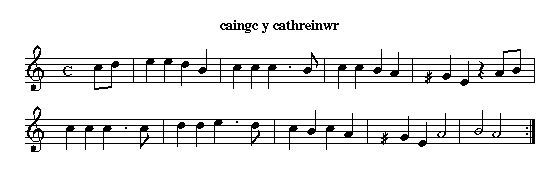
X:3
T:caingc y cathreinwr
S:ifor ceri ms
A:morgannwg
M:C
L:1/4
Q:1/4=180
W:o blin yw damshel pigau dur
W:a blin yw cur y galon
W:ond blinach ydyw colli run
W:a hi ei hun yn foddlon
K:C
c/d/|eedB|ccc>B|ccBA|^GEzA/B/|
ccc>c|dde>d|cBcA|^GEA2|B2A2:|

ifor ceri, or john jenkins, collected many tunes mainly in mid, south and west wales. he was not the first, iolo morgannwg having collected some eighty or so tunes a generation before ifor.

i shan't translate, so as not do purge their melancholy sound.

it has rained for thirty days. today, walking between llangrannog and ynys lochtyn i observed three trees; sloe, rose and gorse, budding. the horizon was rimmed with salmon pink and the calm sea a leaden colour, like salmon skin. to the north, yr eifl were only just visible but to the southwest, the preseli mountains were, in turn, purple, transparent and gold. in the village a street of houses was empty except for one inhabited building. the person explained that all the owners lived away and came back only for the summer. it is raw economics.

mary jones, who i don't know, has an excellent resource here. on it is to be found the juvencus englynion, some of the oldest examples of welsh verse, transcribed in the ninth century, apparently - and suitably wintry


The Three Juvencus Englynion, pp. 48-50.
Niguorcosam nemheunaur
Henoid mitelu nit gurmaur
Mi amfranc dam ancalaur

Nicanu niguardam nicusam
Henoid cet iben med nouel
Mi amfranc dam anpatel

Namercit mi nep leguenid
Henoid is discyrr mi coueidid
Dou nam riceus unguetid

The W. F. Skene Translation, 1869?
I will not sleep tonight, not one hour
Tonight; my houshold is not great.
I and my Franc around our kettle.

I sing not, nor laugh, nor sleep,
Tonight; though drinking the new mead,
I and my Franc around our pot.

No joyousness impresses me,
Tonight; my song is a lament.
Two do not talk to me [with] one speaker.

The Ifor Williams translation, 1932
I shall not boast vain things to-night
My retinue is not very large,
I and my hireling, about our cauldron.

I shall not sing, I shall not laugh, I shall not talk to-night,
Though we drank clear mead,
I and my hireling, about our bowl.

Let no-one ask me for mirth tonight;
Mean is my company.
Two lords...


whilst on the subject of iolo, and one is never far from it a link from mary's page takes us to an etext of some of iolo's english language poetry, which i also copy below as pages can disappear. their pastoral joy is perhaps a little out of context in this post but the pills and the melancholy they purge are not always that different from each other

Iolo | Johan Schimanski | Universitetet i Trømsø | 27.06.99
Iolo Morganwg:

Poems, Lyric and Pastoral (1794)

The following e-text contains a short excerpt from vol.1 of Poems, Lyric and Pastoral (J. Nichols, London 1794) by Edward Williams (=Iolo Morganwg, 1747-1826). See also The "Lyric Pastoral": A Natural Genre?.

Much of the layout and typography has been left intact, but long s (s not followed by a space or by a punctuation mark), spaces before (the more complex) punctuation marks, and "follow-on" words printed in the bottom right corner of each page have been suppressed. Certain words within the text are set in capitals: their initial letters are generally slightly larger than the those in the rest of the word, and this does not show in this version.

Unfortunately, this text being entered manually from a fax of the original, some of the letters had to be guessed at; these are enclosed in , thusly. Page numbers are provided in similar brackets. Also note that

Typed in by Johan Schimanski on the second day of 1993 at the University of Oslo; these texts may be copied & disseminated freely throughout the ether.

Thanks to Richard Crowe & Andrew Hawke of the Geiriadur Prifysgol Cymru for providing the originals at such short notice.


<182:>


C O N T E N T,

A LYRIC PASTORAL.

1. NOW morning meets my gladden'd eyes,
From healthful sleep I jocund rise,
With strength renew'd, and placid mind,
To relish Nature's joys inclin'd,
I speed to meet the fragrant gale
That wantons in the dewy dale;
And, as I pace the ow'ry way,
To sweet Content attune my lay.
<183:>

2. How clad with smiles the vernal morn!
How gay the bloom-bespangled thorn!
The lark is up, the welkin rings,
And with his flock the shepherd sings;
His notes a pleasing thrill impart;
They cheer my soul, and soothe my heart.
Oh! let my days like his be spent,
In rural shades with mild Content.
3. The Blackbird warbles on the bough,
The Milkmaid sings beneath her Cow;
The Mower, up with early dawn,
Prepares to fleece the clover'd lawn;
The Farmer views his blooming wheat*,
And starts the lev'ret from her seat;
* Blooming wheat.] The wheat's bloom is a beautiful, and ver interesting, rural object; though but little, if at all, noticed b modern Poets.

<184:>

Whilst I this lonely vale frequent,
To muse the praises of Content.

4. I verdant mead, and shady grove,
Dear simple scenes of nature, love,
And highly prize my happy lot,
That gave me one sequester'd cot,
Far from the bust of a Crowd,
Far from the mansions of the Proud,
And gave, to crown the blest event,
The tranquil feelings of Content. 5. Pleas'd with my little flock of sheep,
That on my native downs I keep;
Mine are the joys of Peace and Health,
And sure I want no greater wealth;
No vain desires my soul infest,
Nor dwells Ambition in my breast.
Heav'n, all such follies to prevent,
Tam'd all my thoughts to soft Content.
<185:>

6. Oh! thou from whom all comfort flows,
Whose hand the richest boon bestows,
Whose careful Providence imparts,
The purest bliss to humble hearts;
Oh! let me never find content,
But in meek thoughts on virtue bent;
Whilst, of thy laws enamour'd still,
I bow submissive to thy will.
__________

<186:>


A S O N G.

1. WITH Phillis alone in the grove,
I pass'd the still ev'ning away;
My song was the tale of our love,
She smil'd, and approv'd the lay.
I felt the sweet glance from her eyes,
It open'd the way to her heart;
And Phillis could never disguise
Her looks with the varnish of Art. 2. The blush that appear'd on her face
Out-rival'd yon rose in the grove;
It spoke with ineffable grace
The wordless confession of Love;
Whilst Modesty brighten'd her charms,
And sweet looks her affection express'd,
I took the clear nymph in my arms,
And held her with joy to my breast.
<187:>


T H E P A R T I N G,

A LYRIC PASTORAL.

1. LIFE yields no joy devoid of care,
It is our doom awhile to part;
But whilst I go, my lovely fair,
I leave with thee my constant heart;
Thy Colin shall, in plaintive song,
The stories of our love rehearse;
And, as the moment glides along,
Thy name shall fill my tender verse.
<188:>

2. I'll sing the well-remember'd hour,
When first I felt thy peerless charms;
When first, within this privet bow'r,
Thy beauties fill'd my circling arms;
I'll sing the sweet sequestered walk,
Or seat beneath yon aged thorn;
Where oft we met for tender talk,
At ev'ning mild, or dewy morn. 3. Whilst far from Delia sadly thrown,
And by Misfortune rudely tost,
Pursu'd by Fate's malignant frown,
In all my soul's enjoyment cross'd
The wintry storm will fleet away;
I'll bear those ills a little while;
And keep in view that happy day,
When thou shalt meet me with a smile.
<189:>

4. Wilt thou, my Delia, keep my heart
Still faithful as the turtle dove?
And let no swain, with baleful art,
Induce thee to forget my love?
My soul to thee shall true remain,
Till Fate, in pity to my sighs,
Relenting kindly, shall again
Restore thee to my longing eyes. 5. Wilt thou frequent our fav'rite bow'r,
And wilt thou there in silence mourn,
Till time brings on the blissful hour,
That sees thy lover's wish'd return;
When Colin in its green alcove,
With Delia meets, no more to part;
Whilst, in that eye, the look of love,
Restores thee to my joyful heart?
<190:>

6. Whilst on this tender theme I muse,
It yields my soul a soft relief;
Hope brightens up its lovely views,
And charms away the glooms of grief.
Though Fate our envy'd bliss delays,
And dooms thy Colin far to rove;
Yet we shall end ur happy days,
United in the bands of love.
The Reader will observe, that the term Lyric Pastoral has been often used, and will, perhaps ask, for what reason?—It is this—We often observe Shepherds, and other rural characters, diverting themselves with songs, which are always, in the proper sense of the word, sung to a tune; the verse of course must be Lyric<.> SHENSTONE'S Pastoral Ballads are, for this reason, amongst others, far more natural than the Bucolics of Theocritus, Virgil, and many more that could be named; this at last is a<191:> Welsh Bard's opinion, who admits of no authority but that of NATURE. We often hear the fields resound with Chevy Chase, Tweed Side, and such popular songs. Shepherds, Ploughmen, and Goatherds, will often write verses to favourite tunes in praise of their Phillidas, their Annies, and their Delias. But we never meet with them spouting Heroics, "sub tegmine fagi." At least it is thus in every part of BRITAIN. But some, it seems, are of the opinion that we should write for other countries, climates, and times, rather than our own. Bravo! my good Critics!

__________

<147:>

P A S T O R A L.

In the Welsh Manner*.

1. AN arbour sequester'd I found,
Of hawthorn, with woodbines attir'd<;>
'Tis hid by green thickets around,
'Tis by my dear Phillis admir'd
I led her one day to the place,
From all observation apart;
And, urg'd with a lover's embrace,
I told her of my heart!
* There is nothing in the Welsh poetic taste, however deftive in other respects it might appear, absurdly derived from mythology, sentiments, and scenery<,> of the Greek and Ro Poets; but all is the natural growth of BRITAIN.

<148:>

2. See, Phillis, the gladness of Love<,>
On ev'ry sweet object impress'd;
It softly distills from above,
To soothe our afflictions to rest;
Though saddest misfortunes arise,
Assuming each terrible form;
Love's willing attention supplies
A shield that can battle the storm.
3. Unblest are all those who decline
What Love, only Love, can bestow!
Nought else can our pleasures refine,
Nought else of true comfort we know;
'Twill brighten the gloom of our days,
'Twill keep our best feelings awake;
O! let us, avoiding delays,
Of Love's balmy raptures partake.
<149:>

<4.> Observe the gay thickets and
The skies that are fulgent above;
The fragrance we breathe in the gales;
All die with the season of Love!
For, all that is charming of Spring,
The Summer's high fervor will burn;
And, bearing the storm on it's wing,
Stern Winter will quickly return. 5. How sweet are the valleys of May!
Delicious the mornings of June!
We'll prize them, be jocund and gay,
To joy the new carol attune;
The birds have a musical strain!
How fragrant the beautiful rose!
But, seeking, we seek them in vain,
When woodlands are cover'd with snows.
<150:>

6. Our moments incessantly waste,
Soon vanish unheeded away;
Youth flies on the pinions of haste,
Nor listens to mortal delay;
Then let us, my Phillis, improve
Our time that is dwindling apace,
And, yielding to Nature and Love,
The joy that's allow'd us embrace!


and follows a return to wintery coldness in a song, originally noted by iolo, rendered in my dialect

fi wn lle ma gwitw tu wnt i gyrdydd
lle gallwn ga'l decpunt i ala bob dydd
a finne duw'm elpo mor wan ac mor wa'l
yn caru merch ifanc heb ddim iddi'i ga'l


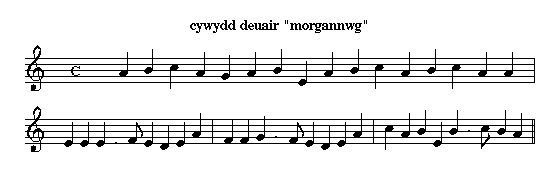
here is an old tune pricked down by iolo morgannwg. it is not related to the verse. i am indebted to daniel huws of penrhyncoch who lent me his copy of the original. the barring is as pricked by iolo


X:1
T:cywydd deuair "morgannwg"
O:LLGC Llsgrau Iolo Aneurin Williams heb eu catalogio
N:priciad Iolo Morgannwg (Edward Williams)
M:C
L:1/4
K:C
ABcAGABEABcABcAA|
EEE>FEDEA|FFG>FEDEA|cABEB>cBA||

8.11.06

perllan

gair cloi parthed a'r berllan onedig. dyma rester o'r fale (a'r pers ne'r gellyg) a'u cymare sy wedi'u blannu yn barod (ar y gwilod) - a'r rheini sy i ddod (ar y top) llun i ddilyn

black worcester (xcatillac) = pitmaston duchesse (xbeth)

d'arcy spice des 14 D =cornish aromatic des 15 D
essex1785


devonshire quarrenden des B = burr knot ck 9C
1676 popular in s wales


court pendu plat des 26G = lodgemore nonpareil )des 23F
1610 1808 glos

tom putt sdr 10C =morgan sweet S B
dorset somerst 1700 / swales


afallon1

ashmeads kernel des 14D
glos ruset 1700

discovery (thurston august) des 11C
essex (worcester pearmain x possibly with beauty of bath) 1949

grenadier ck 11C
slough.1862

lord derby ck 14D
cheshire 1862

lord lambourne) des 8C
beds (james grieve x worcester pearmain) 1907

sunset des 10C
kent (raised from a cox's orange pippin) 1918

saint cecilia des 7B
(raised from a cox's orange pippin?)

twll tin gwydd des/ ck 7B
llangadog


wish list: perthyre, pitmaston pine apple, monmouth green/landore, cissy

y gwir yw hornpipes yw fale wedi'u blanu miwn cordon. dyma gwd hornpipe

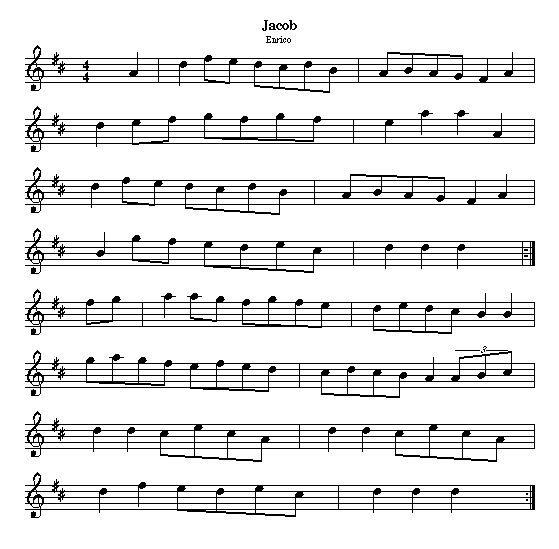
X:1
T:Jacob
T:Enrico
M:4/4
L:1/8
Q:1/4=90
S:Mobberley session
R:English reel
N:Posted to the woodenflute mailing list November 2001. JACOB. AKA and see "Enrico." English, Reel. England, Dorset. D Major. Standard. AABB. See note for “Enrico” for more. Trim (Thomas Hardy), 1990; No. 13.
ENRICO. AKA – “Henryco,” “Water Loo Fair.” AKA and see "Jacob." English, Reel. D Major. Standard. AABB. The melody's original title was "Jacob," but was retitled by English author and musician Thomas Hardy. It was his favorite tune. The title appears in Hardy's (who was also an accomplished accordion player and fiddler) drama The Dynasts:
***
Let us go and look at the dancing. It is 'Voulez?vous danser'
? no, it is not, ? it is 'Enrico' ? two ladies between two gentlemen.
***
According to Hardy’s biography, the four-year old Hardy would sometimes burst into tears when his father played this and other tunes to him on the fiddle. Hardy, around the year 1925, wrote that “Enrico” was the usual vehicle for the country dance called Bonnets of Blue, or in Dorset when he was young, Hands Across. In his novel Under the Greenwood Tree the dance is described (but not named) as the one in which Shiner refuses to cast off (E.F.D.S. News, No. 12, Sept., 1926). The Welch manuscript gives the alternate title “Water Loo Fair” (while calling “Enrico” by the name “Henryco”). Trim (Thomas Hardy), 1990; No. 13 (appears as “Jacob”). BEJOCD-28, The Mellstock Band – “The Dance at Pheonix: Village Band Music from Hardy’s Wessex and Beyond.”
Z:Steve Mansfield January 2001
K:D
A2 | d2 fe dcdB | ABAG F2 A2 |
d2 ef gfgf | e2 a2 a2 A2 |
d2 fe dcdB | ABAG F2 A2 |
B2 gf edec | d2 d2 d2 ::
fg | a2 ag fgfe | dedc B2 B2 |
gagf efed | cdcB A2 (3ABc |
d2 d2 cecA | d2 d2 cecA |
d2 f2 edec | d2 d2 d2 :|


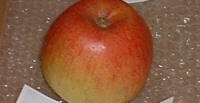
a dyma i chi gwd afal - sant cecilia hy - nawddsantes cerddorion dim llai


buws yn boblogedd ym mynwy y ganrif dwytha C20 hy.